Book: Flier and Cover Art – Analyzing social media networks with NodeXL: Insights from a connected world
Cover art and promotional flier for Analyzing social media networks with NodeXL: Insights from a connected world.


Along with Professors Ben Shneiderman (Computer Science/Human Computer Interaction Lab) and Derek Hansen (College of Information Studies) from the University of Maryland I am writing and editing a book about analyzing the social media networks that form whenever people link or reply to one another, favorite, rate, read, or edit data about other people or their objects. Social media networks can be analyzed using the methods of social network analysis, the mathematical application of graph and network theory to the social sciences. Using social network analysis collections of connections can be analyzed and compared to identify key people and groups and measure changes over time and following interventions.

I am pleased to announce that we have signed with Elsevier/ Morgan Kaufmann to produce a book: Analyzing Social Media Networks with NodeXL: Insights from a Connected World for a Summer 2010 delivery!
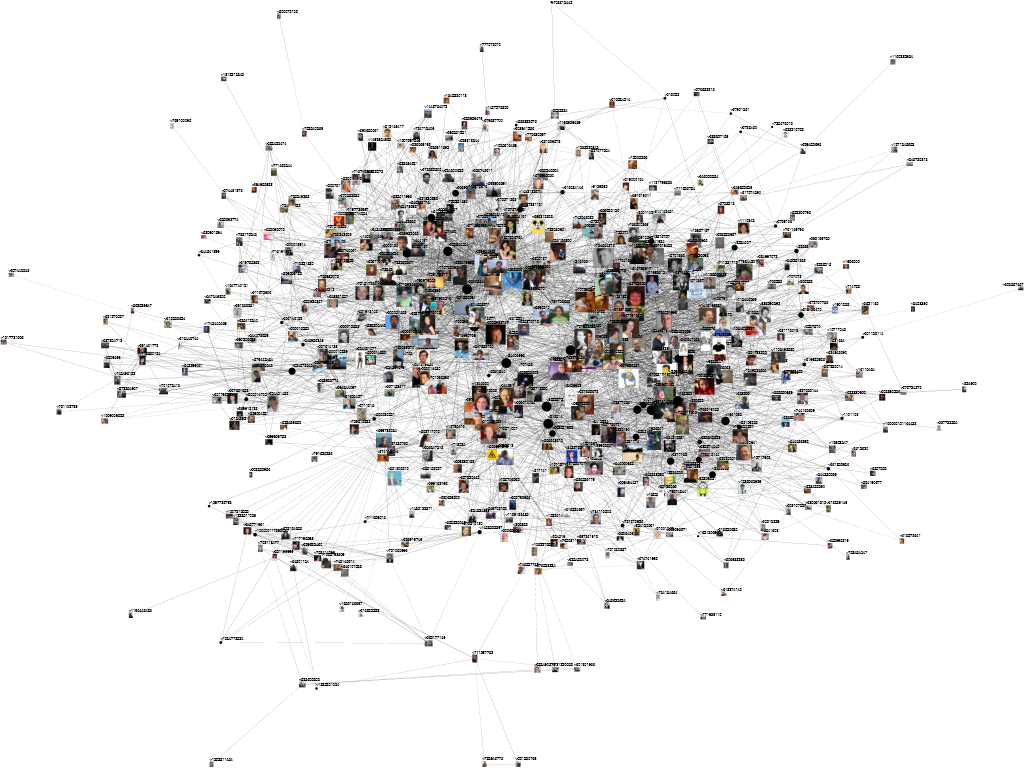
A map of the relationships among the population of people who all tweet a particular keyword can lead to the discovery of the key hubs and influential people in the network. A social network analysis of reply patterns in email collections displays clusters around projects and highlights key people and relationships. Visualizing the connections among your friends in Facebook can reveal the various life stages and communities in which you have participated. When you chart the links between videos and users in YouTube content with interesting network properties is exposed based on well connected content creators and influential commentators. A graph of the individual connections between flickr users illustrates the emergent formation of groups around social networks, locations, and topics.
These kinds of social media network data collection, scrubbing, analysis, and display tasks have historically required a remarkable collection of tools and skills. A great example of the variety of tools that can be used in concert to extract, analyze and display social media networks can be found on Drew Conway’s blog. This is a powerful set of tools for those who can master the demands of python and API interfaces. In contrast, the approach the NodeXL project has taken is to provide an end-user GUI application environment built within the framework of Excel 2007 for performing basic social media network analysis and visualization for non-programmers. The python path is certainly the high road for experts and those with demanding volumes or esoteric data requirements. But for the non-coding user, NodeXL may be one of the easiest ways to both manipulate network graphs and get graphs from a variety of social media sources.
There are already some materials available to guide new users interested in learning about NodeXL, social networks, and social media. A video tutorial for NodeXL demonstrates the extraction of the network of people in twitter who mentioned the term “digg”. A tutorial guide to NodeXL offers a step by step guide to features in the NodeXL toolkit (with supporting data sets). But the book will capture the theory, history, domain and process of social media network analysis in a single volume.
The volume contains a broad introduction to social media, social networks and the operation of the NodeXL application and then features a series of chapters from leading researchers that focus on a particular social media system (email, Facebook, Twitter, YouTube, flickr, Wikis, the WWW hyperlink network) and the networks each contains (replies, friends, follows, subscribes, comments, favorites, edits, links, etc). A final chapter outlines a programmer’s view of the NodeXL code, in contrast to the code-free approach of the remainder of the book.
Our intended audience is the mostly non-programming population that is interested in social media and the techniques of social network analysis. The volume is largely in the form of a how-to guide that readers can follow and replicate all examples. Using your own free and open copy of NodeXL, you will be able to use sample data sets or create similar live queries that map relationships in social media systems.
We have an ambitious production schedule so the book may be on a book store shelf or online retailer search result in summer 2010.
Table of contents…
When the late Peter Kollock and I published Communities in Cyberspace with Routledge in 1999 there were few broadband connections, no iPhones, and little WiFi. Today, there is an ebook version of the book and Amazon sells a version for the Kindle, a device it was hard to even imagine when the book was written. Google lets you browse most of it and search all of it. But the key ideas of the volume: identity, interaction, collective action and emergent order remain relevant in a wireless broadband netbook mobile social network real-time web world. The book is now ten years old.
I. Introduction
Introduction to Communities in Cyberspace, Peter Kollock and Marc Smith
“Since 1993, computer networks have grabbed enormous public attention. The major news and entertainment media have been filled with stories about the “information superhighway” and of the financial and political fortunes to be made on it. Computer sales continue to rise and more and more people are getting connected to “the Net”. Computer networks, once an obscure and arcane set of technologies used by a small elite, are now widely used and the subject of political debate, public interest, and popular culture. The “information superhighway” competes with a collection of metaphors that attempt to label and define these technologies. Others, like “cyberspace,” “the Net,” “online,” and “the web,” highlight different aspects of network technology and its meaning, role and impact. Whichever term is used, it is clear that computer networks allow people to create a range of new social spaces in which to meet and interact with one another.”
More details from the book…
The Second Conference on Online Deliberation: Design, Research, and Practice (OD2005/DIAC-2005) was held at Stanford University May 20-22, 2005. From that event there is now a book, Online Deliberation: Design, Research, and Practice, edited by Todd Davies and Seeta Peña…

A new book E-Research: Transformation in Scholarly Practice edited by Nicholas W. Jankowski on the ways social science research is being changed by the rise of social media has just been released by Routledge. My colleagues and I contributed a chapter on the ways that information visualization of social media is a useful technique to identify research questions and discover answers about the nature of human association when mediated by computation. The volume contains work from an all-star line-up of researchers who address the opportunities and challenges of performing research with computer-mediated data about social life.
The blurb about the book describes it as:
“No less than a revolutionary transformation of the research enterprise is underway. This transformation extends beyond the natural sciences, where ‘e-research’ has become the modus operandi, and is penetrating the social sciences and humanities, sometimes with differences in accent and label. Many suggest that the very essence of scholarship in these areas is changing. The everyday procedures and practices of traditional forms of scholarship are affected by these and other features of e-research. This volume, which features renowned scholars from across the globe who are active in the social sciences and humanities, provides critical reflection on the overall emergence of e-research, particularly on its adoption and adaptation by the social sciences and humanities.”
Our chapter is “A Picture is Worth a Thousand Questions: Visualization Techniques for Social Science Discovery in Computational Spaces”, co-authored by Howard T. Welser, Thomas Lento, Marc Smith, Eric Gleave and Itai Himelboim. In it, we describe the ways that using information visualizations of social media data sets is a useful way of discovering insights, patterns, and clusters. We illustrate the paper with several examples of social media information visualizations that display the range of behavior among contributors to social media spaces.
Here is the table of contents for the volume:
This year’s CITASA awards have been announced! CITASA is the Communications and Information Technology section of the American Sociological Association. It gathers together more than 300 sociologists interested in the ways groups of people make use of computation and networks.…