In the most recent prior release of NodeXL we added new metrics that describe networks in terms of their number of components and the length of paths in those networks. In this release we automate creation of histograms of network…
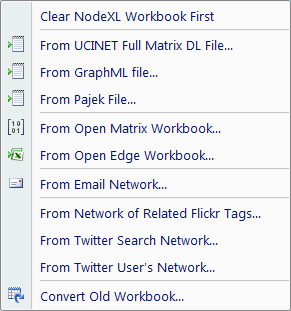
Version 95 of NodeXL is hot off the compiler and we are pleased to announce several major features that create a social media network analysis dashboard. From the NodeXL interface it is now possible to import networks from twitter, flickr, email, and a range of social network file formats. Coming soon: support for more spigots – the connectors that pull data from leading social media sources.
What social media data most interest you? We are considering integration with web and wiki crawlers, and support for YouTube, delicious, and enterprise data sources like Active Directory (LDAP), SharePoint, and Exchange.
This release also improves support for images, particularly those pulled from URLS, like twitter or facebook profile photos!
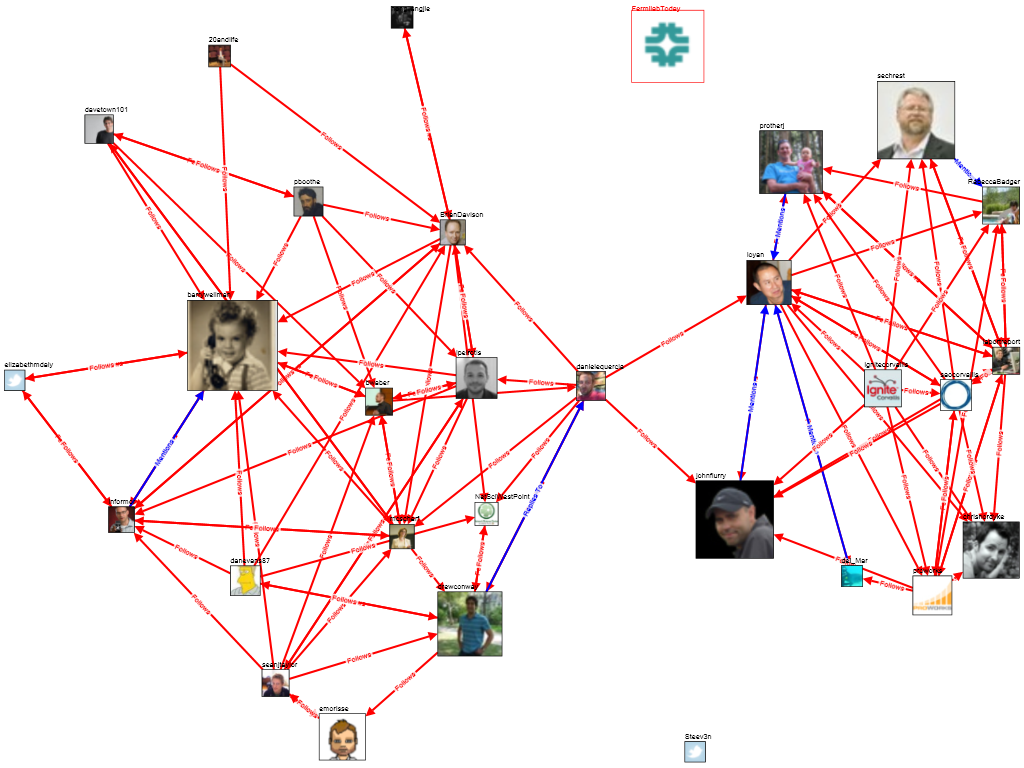
Here, for example, is a map of the connections among twitter accounts that tweeted the “WIN09” tag that was used in the recent Social Networks Summit at NYU (http://winworkshop.net/) The map illustrates the way the summit brought together previously separate clusters of people from the various disciplines that have been attracted to the study of networks in general and social networks in particular. Size of the image equals the number of tweets that person created.
A refined version adds Edge Labels and color to highlight the different tie types in the graph: “follows” relationships and “replies to” and “mentions” and now scaled by “Followers”.
In both views, the high betweenness role of one twitter account is clear.
My colleagues Derek Hansen and Ben Shneiderman (University of Maryland) and I have just finished the second version of our tutorial/manual for the NodeXL social network analysis toolkit for Excel.
The latest version of the tutorial Analyzing Social Media Networks: Learning by Doing with NodeXL is now available from the University of Maryland Center for the Advanced Study of Communities and Information (CASCI) web site. We will use this version of the document in our upcoming tutorial at the Communities and Technologies conference at Penn State University on June 24th.
We plan to continue to expand the tutorial to include a step-by-step guide to the analysis of several major social media sites like Twitter, Facebook, Wikipedia, YouTube, delicious, and flickr as well as personal stores of social media like your own email (if it is stored in a Windows Search Index found on most Windows desktops). Our goal is to create an easy-to-follow guide to network theory for people who new to the field or who do not want to develop programming skills to perform network analysis. We are focused on social media as a data source for social media although other examples are included, like the United States Senate voting network that reveals interesting patterns in the connections created when votes are cast. Using 2007 data it reveals which Senators are most likely to change party affiliation.
Your comments, corrections, and suggestions for improving the document are welcome.
Instructors interested in teaching classes about social networks are welcome to make use of both the NodeXL toolkit and the document to guide students through the core concepts of social network theory.
The Communities and Technologies conference is holding its 4th meeting in Penn State June 24-27. This conference gathers a range of scholars interested in online community, social media, social networks, and mobile social software. A paper "Analyzing (Social Media) Networks…
Last week’s NodeXL meeting focused on the coming work items for the next release. Four major items are lined up for the next few weeks. We may publish a release once a few of these items are complete.
> Legends and axes with scale marks for the chart canvass.
This is part of our larger work item called “Make the charts ready to publish”. A related work item to address this goal is export to a vector file format. A scalable vector format will allow people to create graphs of arbitrary resolutions to fit their presentation needs.
> Export to XPS (which should make it possible to get our files to PDF with some 3rd party help!)
Since NodeXL is intended to support non-programmer network analysts we plan to add support for other network analysis file formats. A leading example is the UCINet format which has the added virtue of holding many sample data sets that are widely used in classes and network course work. If you have a network data file format you would like NodeXL to support feel free to comment here or on the Codeplex NodeXL discussion.
Improvements to the layout of complex graphs is a deep area of research. A recent member of the NodeXL team, Janez Brank has proposed and prototyped an alternative mechanism for node layout, namely the Fast Multi-Scale Method from Harel and Koren. This method initially selects a small subset of nodes and lays them out; this initial layout is then refined in several iterations, with more and more nodes added to the layout in each iteration, until a layout of the entire graph is created. The cost function used to optimize the layout at each step is designed to reward layouts in which the Euclidean distance between nodes corresponds approximately to the length of the shortest path between them. Our developer, Tony Capone, plans to implement the design in the coming weeks. We have not added a new layout for a while and those recent additions have been deterministic geometric layouts like grid, circle, and sine wave. We have never added an alternative to the Fruchterman-Reingold force directed layout with which we started the project. This is a big feature addition that should have a big impact in making NodeXL layouts more visually appealing and informative.
> Updated layout #1
We hope these features deliver a lot of value to our users and address the big themes the team is working towards: Scale, Clarity, and Connection. We seek to make NodeXL perform against reasonably sized data sets, to improve the exploration and discovery of structures in graphs, and to simplify the import and export of data between NodeXL and social media network data sources beyond the email and Twitter support present in the application today.
Some other features that we have been considering include:
New menu items have been added to NodeXL in the v.85 release made available today! These "Visual Properties" features are part of a larger set of work items intended to make it easier to manipulate and decorate a network graph…