After visiting the Oxford Internet Institute on December 4th, I will be visiting Aachen University to talk about social media network analysis this December 7th and 8th. I will be visiting with my hosts, Zinayida Petrushyna and Ralf Klamma who have…
On December 4th, I will be attending the Oxford Internet Institute's Forum on Relationships and the Internet which will feature researchers focused on computer-mediated relationships. Rather than being used primarily to access information, people often use networked computing to access…
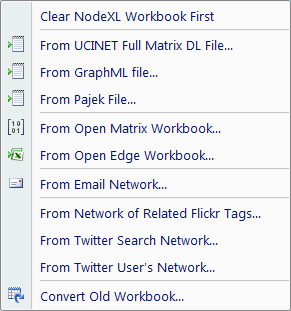
Version 95 of NodeXL is hot off the compiler and we are pleased to announce several major features that create a social media network analysis dashboard. From the NodeXL interface it is now possible to import networks from twitter, flickr, email, and a range of social network file formats. Coming soon: support for more spigots – the connectors that pull data from leading social media sources.
What social media data most interest you? We are considering integration with web and wiki crawlers, and support for YouTube, delicious, and enterprise data sources like Active Directory (LDAP), SharePoint, and Exchange.
This release also improves support for images, particularly those pulled from URLS, like twitter or facebook profile photos!
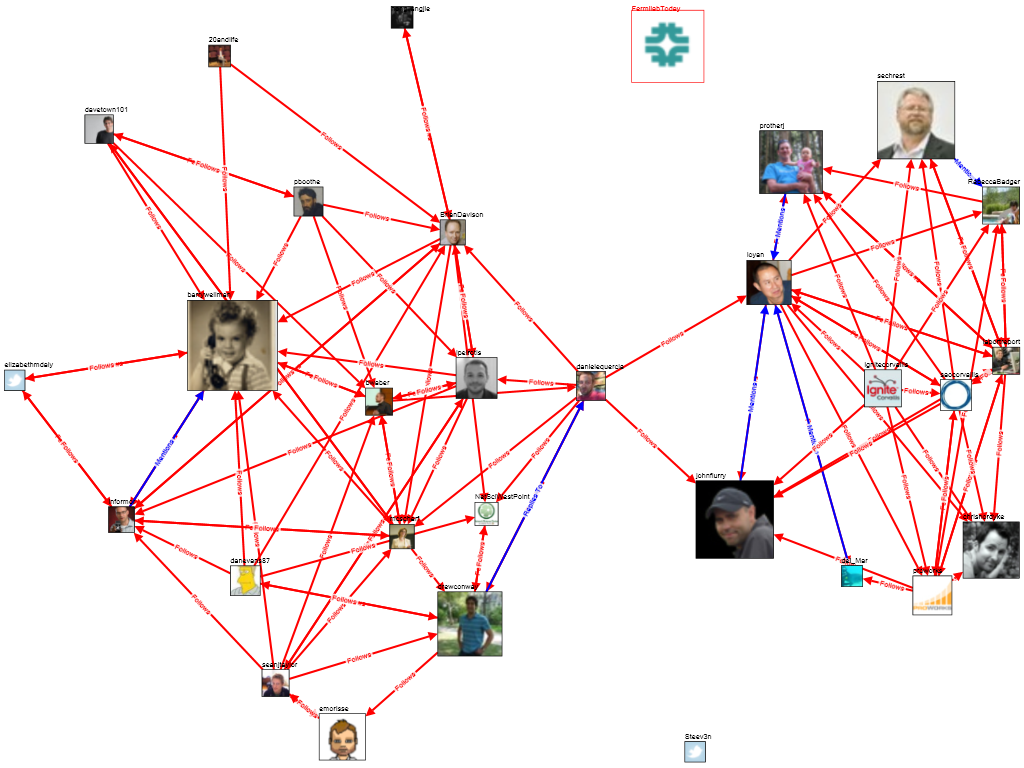
Here, for example, is a map of the connections among twitter accounts that tweeted the “WIN09” tag that was used in the recent Social Networks Summit at NYU (http://winworkshop.net/) The map illustrates the way the summit brought together previously separate clusters of people from the various disciplines that have been attracted to the study of networks in general and social networks in particular. Size of the image equals the number of tweets that person created.
A refined version adds Edge Labels and color to highlight the different tie types in the graph: “follows” relationships and “replies to” and “mentions” and now scaled by “Followers”.
In both views, the high betweenness role of one twitter account is clear.
My colleagues Derek Hansen and Ben Shneiderman (University of Maryland) and I have just finished the second version of our tutorial/manual for the NodeXL social network analysis toolkit for Excel.
The latest version of the tutorial Analyzing Social Media Networks: Learning by Doing with NodeXL is now available from the University of Maryland Center for the Advanced Study of Communities and Information (CASCI) web site. We will use this version of the document in our upcoming tutorial at the Communities and Technologies conference at Penn State University on June 24th.
We plan to continue to expand the tutorial to include a step-by-step guide to the analysis of several major social media sites like Twitter, Facebook, Wikipedia, YouTube, delicious, and flickr as well as personal stores of social media like your own email (if it is stored in a Windows Search Index found on most Windows desktops). Our goal is to create an easy-to-follow guide to network theory for people who new to the field or who do not want to develop programming skills to perform network analysis. We are focused on social media as a data source for social media although other examples are included, like the United States Senate voting network that reveals interesting patterns in the connections created when votes are cast. Using 2007 data it reveals which Senators are most likely to change party affiliation.
Your comments, corrections, and suggestions for improving the document are welcome.
Instructors interested in teaching classes about social networks are welcome to make use of both the NodeXL toolkit and the document to guide students through the core concepts of social network theory.
The Communities and Technologies conference is holding its 4th meeting in Penn State June 24-27. This conference gathers a range of scholars interested in online community, social media, social networks, and mobile social software. A paper "Analyzing (Social Media) Networks…
The upcoming Enterprise 2.0 conference in Boston June 22-25 features several presentations of possible interest. George Dearing and I will both be on panels and, centrally, there is a presentation from Telligent co-founder Rob Howard about what is new at Telligent Systems:
Enterprise 2.0: Work, Productivity and ROI Today’s ever-changing workforce requires that enterprises tackle an array of shifting demands. Adapting to the various ways people collaborate and work together without actually being in the same place is now an organizational necessity, not just an option. Join us for this informative session as Rob Howard, Founder of Telligent and an innovator of online collaboration strategies, presents Enterprise 2.0 and social computing in the context of work, productivity and ROI. Enterprises that have embraced collaborative computing and analytics are realizing results in increased workforce productivity, expanded input and insight from customers and partners, and now have the ability to manage and report on the value of these efforts. Join us for this session and walk away understanding how you can prepare today for the future of work.
George Dearing from Telligent and I will both be on additional panels at the conference. I am looking forward to the chance to present along with Kate Niederhoffer from Dachis again; we presented at Web 2.0 on the topic of “Beyond Buzz: On Measuring a Conversation” which I think was well received. Details below: