Title: Visualizing collections of social media connections: using social network analysis to assess, evaluate and measure social media engagement
Abstract: Social networks are created whenever people interact. These networks become more visible when interactions take place through social media. Social networks form when people link, reply, comment, edit, tag, and friend one another. Sub-populations are formed whenever people mention the same company, products, event, topic, or personality. Using social network analysis on collections of social media connections reveals important patterns: how are people clustered and grouped, where are the gaps, who plays the roles of bridge, hub, and isolate? In this talk I will display maps of twitter, you tube, flickr, and enterprise email systems and demonstrate several tools that can be used to collect, analyze, map and monitor social media, including the free and open NodeXL (network overview, discovery and exploration) add-in Excel 2007.
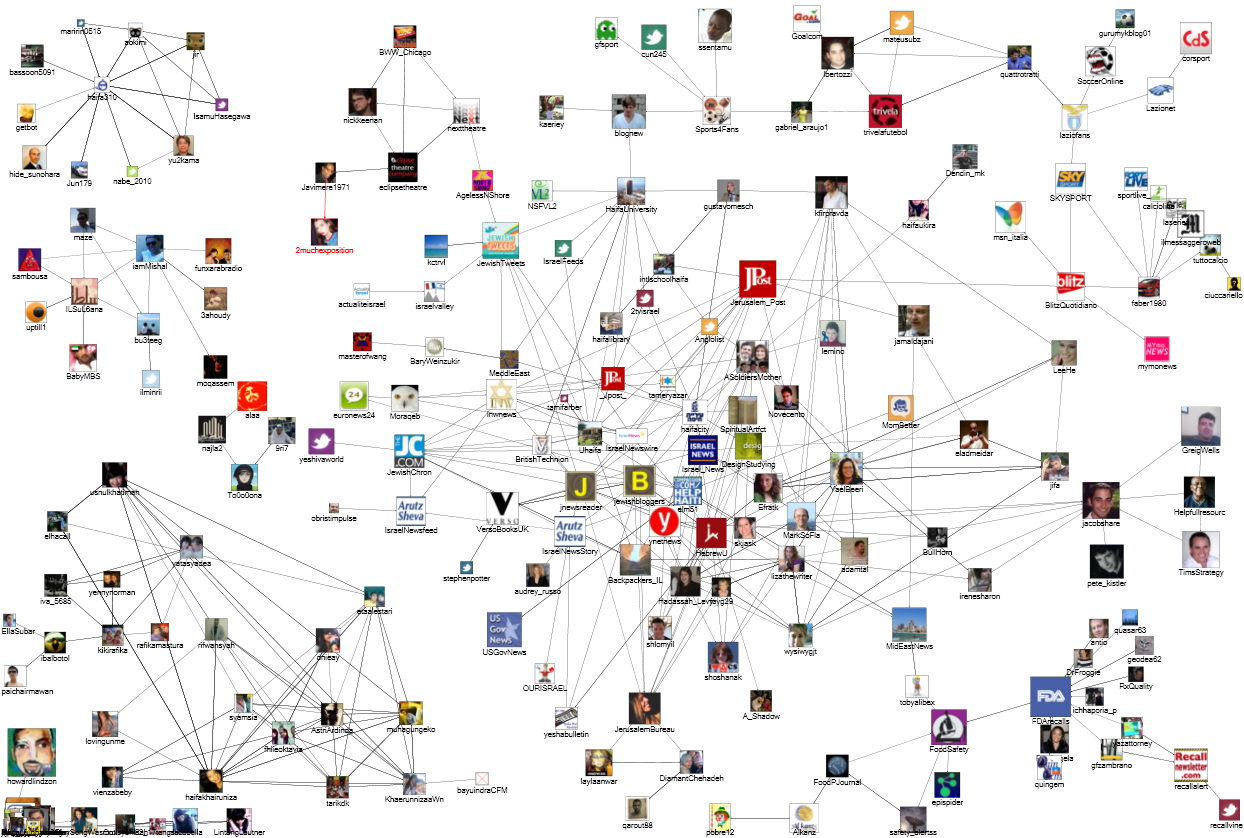
Here, for example, is a map of the connections among people who recently mentioned “haifa” in twitter sized by number of followers:
Some photos taken during the trip are available after the jump:
I am pleased to announce that we have signed with Elsevier/ Morgan Kaufmann to produce a book: Analyzing Social Media Networks with NodeXL: Insights from a Connected Worldfor a Summer 2010 delivery!
A map of the relationships among the population of people who all tweet a particular keyword can lead to the discovery of the key hubs and influential people in the network. A social network analysis of reply patterns in email collections displays clusters around projects and highlights key people and relationships. Visualizing the connections among your friends in Facebook can reveal the various life stages and communities in which you have participated. When you chart the links between videos and users in YouTube content with interesting network properties is exposed based on well connected content creators and influential commentators. A graph of the individual connections between flickr users illustrates the emergent formation of groups around social networks, locations, and topics.
These kinds of social media network data collection, scrubbing, analysis, and display tasks have historically required a remarkable collection of tools and skills. A great example of the variety of tools that can be used in concert to extract, analyze and display social media networks can be found on Drew Conway’s blog. This is a powerful set of tools for those who can master the demands of python and API interfaces. In contrast, the approach the NodeXL project has taken is to provide an end-user GUI application environment built within the framework of Excel 2007 for performing basic social media network analysis and visualization for non-programmers. The python path is certainly the high road for experts and those with demanding volumes or esoteric data requirements. But for the non-coding user, NodeXL may be one of the easiest ways to both manipulate network graphs and get graphs from a variety of social media sources.
There are already some materials available to guide new users interested in learning about NodeXL, social networks, and social media. A video tutorial for NodeXL demonstrates the extraction of the network of people in twitter who mentioned the term “digg”. A tutorial guide to NodeXL offers a step by step guide to features in the NodeXL toolkit (with supporting data sets). But the book will capture the theory, history, domain and process of social media network analysis in a single volume.
The volume contains a broad introduction to social media, social networks and the operation of the NodeXL application and then features a series of chapters from leading researchers that focus on a particular social media system (email, Facebook, Twitter, YouTube, flickr, Wikis, the WWW hyperlink network) and the networks each contains (replies, friends, follows, subscribes, comments, favorites, edits, links, etc). A final chapter outlines a programmer’s view of the NodeXL code, in contrast to the code-free approach of the remainder of the book.
Our intended audience is the mostly non-programming population that is interested in social media and the techniques of social network analysis. The volume is largely in the form of a how-to guide that readers can follow and replicate all examples. Using your own free and open copy of NodeXL, you will be able to use sample data sets or create similar live queries that map relationships in social media systems.
We have an ambitious production schedule so the book may be on a book store shelf or online retailer search result in summer 2010.
NodeXL updated starting with version 1.05 with features that make it fairly easy to create basic "Venn Diagrams". A Venn diagram is a familiar way to illustrate the overlap (or lack thereof) of two or more "sets" of things. There…
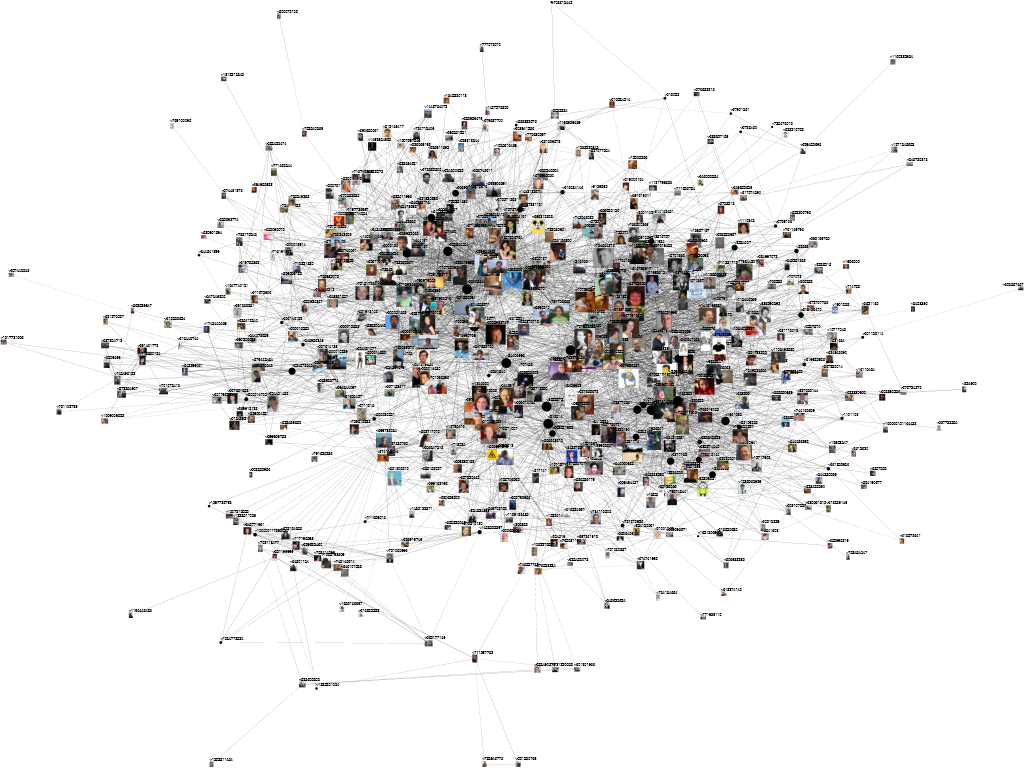
Network visualizations can be very compelling but they are often a smear of unintelligible nodes and edges without refinement and filtering. Creating an automated layout for a complex graph is a challenging area of mathematics and computer science. Several layouts…
Video is now available from a panel hosted by the Women's Affinity Group of O'Melveny & Myers' Silicon Valley Office in Menlo Park on November 19th. Along with Karla Spormann, President and CEO Tendo Communications, Martin Eberhard, Co-founder and former CEO…
Starting in version 100 NodeXL has added a data import feature for extracting social networks from the associations between users and videos in YouTube. The new social media network data spigot offers insights into the ways YouTube is socially structured.…