There are hundreds of conferences sponsored by the ACM on almost every topic related to computing. In some cases the same person will publish a paper in more than one conference, creating a tie between them. Below is a network…
When the late Peter Kollock and I published Communities in Cyberspace with Routledge in 1999 there were few broadband connections, no iPhones, and little WiFi. Today, there is an ebook version of the book and Amazon sells a version for the Kindle, a device it was hard to even imagine when the book was written. Google lets you browse most of it and search all of it. But the key ideas of the volume: identity, interaction, collective action and emergent order remain relevant in a wireless broadband netbook mobile social network real-time web world. The book is now ten years old.
“Since 1993, computer networks have grabbed enormous public attention. The major news and entertainment media have been filled with stories about the “information superhighway” and of the financial and political fortunes to be made on it. Computer sales continue to rise and more and more people are getting connected to “the Net”. Computer networks, once an obscure and arcane set of technologies used by a small elite, are now widely used and the subject of political debate, public interest, and popular culture. The “information superhighway” competes with a collection of metaphors that attempt to label and define these technologies. Others, like “cyberspace,” “the Net,” “online,” and “the web,” highlight different aspects of network technology and its meaning, role and impact. Whichever term is used, it is clear that computer networks allow people to create a range of new social spaces in which to meet and interact with one another.”
Sponsored by the Association for the Advancement of Artificial Intelligence
IMPORTANT DATES: Tutorial Proposals: December 1, 2009 Paper Submission: January 8, 2010 Poster/Demo Submission: January 8, 2010 Paper Acceptance: March 3, 2010 Poster/Demo Acceptance: March 3, 2010 Workshop Submission: March 1, 2010 Camera Ready Copies: March 12, 2010
Featuring a keynote by: Professor Bob Kraut, CMU, on “Designing Online Communities from Theory”
Professor Michael Kearns, Computer and Information Science, Univ. of Pennsylvania, on “Behavioral Experiments in Strategic Networks”
Speakers in Special Sessions: – Nicole Ellison, Dept. of Telecommunication, Information Studies and Media, Michigan State Univ. – James Pennebaker, Dept. of Psychology, Univ. of Texas, Austin – S. Craig Watkins, Dept. of Radio, TV and Film, Univ. of Texas, Austin- Don Burke, CIA Directorate of Science and Technology, Intellipedia – Haym Hirsh, National Science Foundation IIS Division Director – Macon Phillips, U.S. White House, Head of New Media
Tutorial Speakers will include: – Jake Hofman, Yahoo! Research, “Large-scale social media analytics with Hadoop”
– Cindy Chung and James Pennebaker, Univ. Texas, “Using LIWC to uncover social psychology in social media”
NodeXL has had a rudimentary flickr tag network data spigot for some time but we have just added a number of features to this data importer that makes it much more useful. You can now select the number of network…
This is a brief demo video about NodeXL analyzing Twitter social network connections among a group of users who all mentioned the term "digg". 2009 - November - NodeXL - Demo - Mapping Twitter Social Networks "Digg" from Marc Smith…
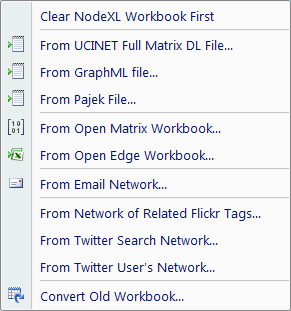
Version 95 of NodeXL is hot off the compiler and we are pleased to announce several major features that create a social media network analysis dashboard. From the NodeXL interface it is now possible to import networks from twitter, flickr, email, and a range of social network file formats. Coming soon: support for more spigots – the connectors that pull data from leading social media sources.
What social media data most interest you? We are considering integration with web and wiki crawlers, and support for YouTube, delicious, and enterprise data sources like Active Directory (LDAP), SharePoint, and Exchange.
This release also improves support for images, particularly those pulled from URLS, like twitter or facebook profile photos!
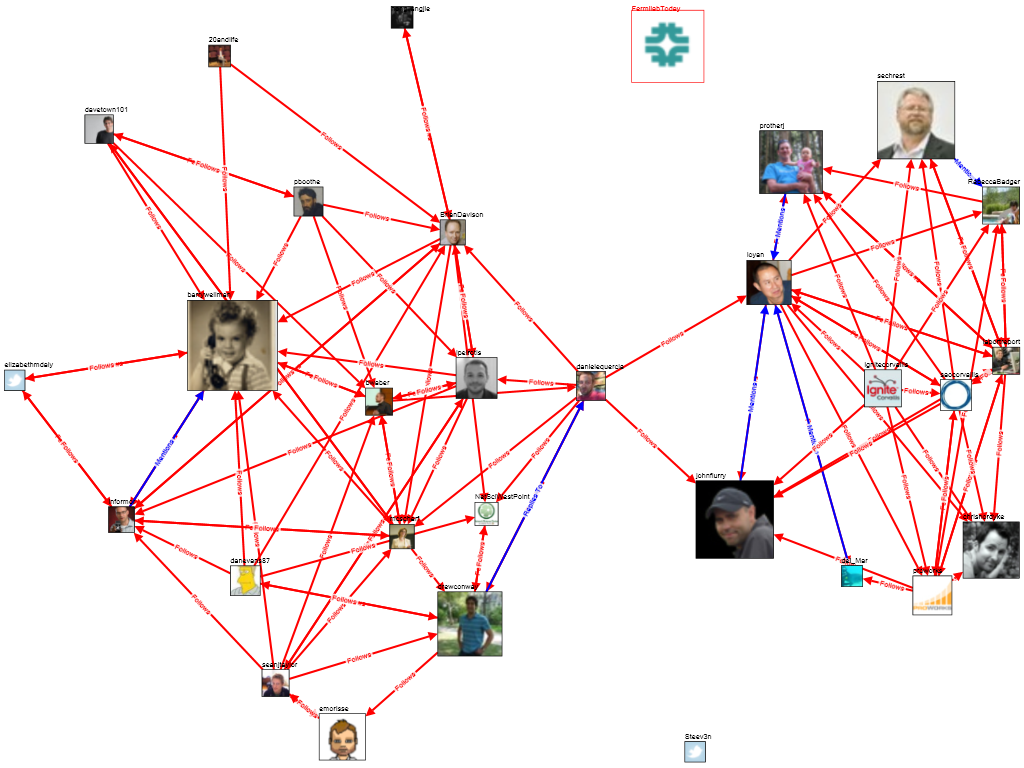
Here, for example, is a map of the connections among twitter accounts that tweeted the “WIN09” tag that was used in the recent Social Networks Summit at NYU (http://winworkshop.net/) The map illustrates the way the summit brought together previously separate clusters of people from the various disciplines that have been attracted to the study of networks in general and social networks in particular. Size of the image equals the number of tweets that person created.
A refined version adds Edge Labels and color to highlight the different tie types in the graph: “follows” relationships and “replies to” and “mentions” and now scaled by “Followers”.
In both views, the high betweenness role of one twitter account is clear.