Last week I made a video with Norm Rose from Travel Tech Consulting about the ways different airlines get talked about in twitter. Norm explores new technologies that impact the travel business and he asked me to create two maps:…
Not all ties are the same. Many networks are collections of multiplex relationships: multiple types of ties link the entities in the graph. NodeXL now (v.1.0.1.120) supports edge styles so that links can have color, width, and style to distinguish…
I will attend and speak at a symposium being heldMarch 24-25, 2010 at the IE University Department of Communication in Segovia, Spain. The topic is: Transnational connections: Challenges and opportunities for communication. "The Symposium aims to generate discussion on cutting-edge ideas in…
The Annual Meeting of the Israel Internet Association (http://www.isoc.org.il (English)) was held February 22-23 2010. I spoke at this year's meeting: http://www.isoc.org.il/conf2010/agenda.php?lang=en Part 1 Part 2 The previous year's conference website is at: http://www.isoc.org.il/conf2009/program.php The Israel Internet Association is the official…
Title: Visualizing collections of social media connections: using social network analysis to assess, evaluate and measure social media engagement
Abstract: Social networks are created whenever people interact. These networks become more visible when interactions take place through social media. Social networks form when people link, reply, comment, edit, tag, and friend one another. Sub-populations are formed whenever people mention the same company, products, event, topic, or personality. Using social network analysis on collections of social media connections reveals important patterns: how are people clustered and grouped, where are the gaps, who plays the roles of bridge, hub, and isolate? In this talk I will display maps of twitter, you tube, flickr, and enterprise email systems and demonstrate several tools that can be used to collect, analyze, map and monitor social media, including the free and open NodeXL (network overview, discovery and exploration) add-in Excel 2007.
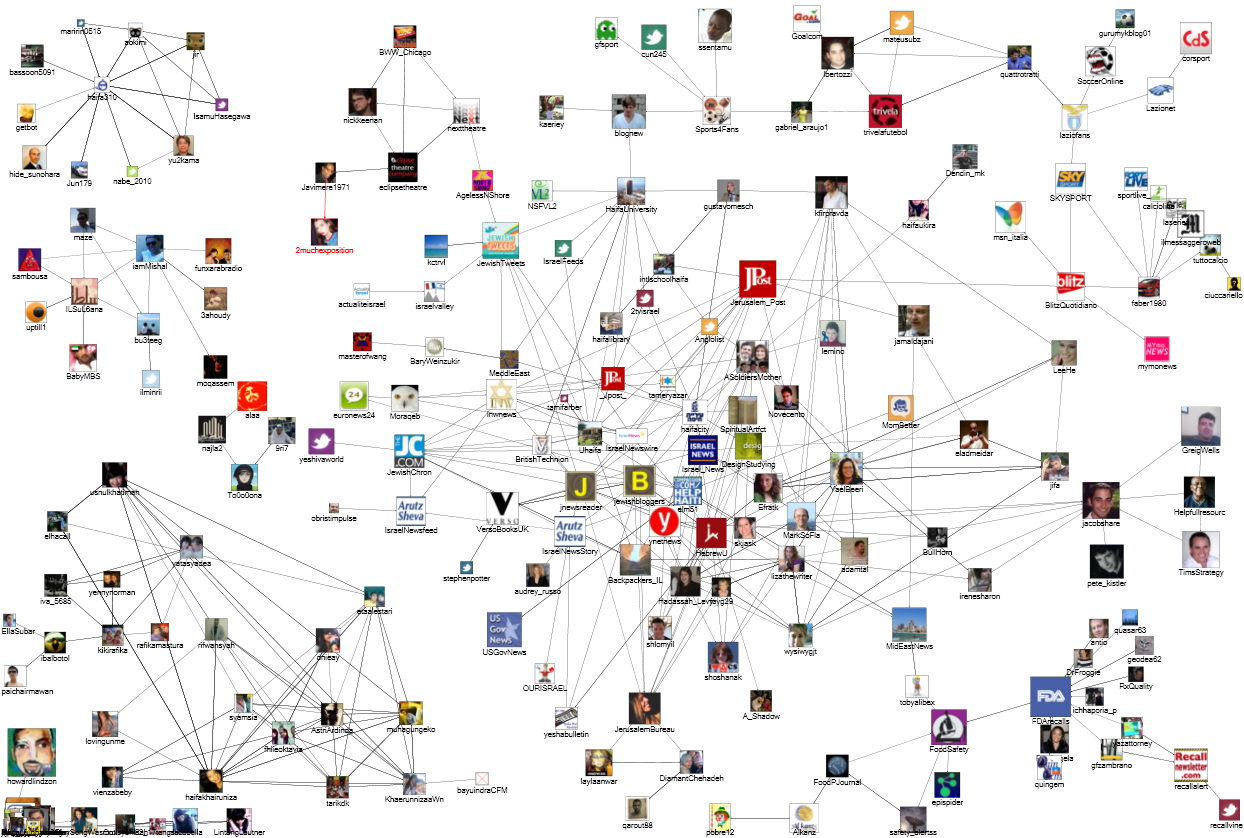
Here, for example, is a map of the connections among people who recently mentioned “haifa” in twitter sized by number of followers:
Some photos taken during the trip are available after the jump:
From family photographs and personal papers to health and financial information, vital personal records are becoming digital. At the same time, creation and capture of new digital information has become a part of the daily routine for hundreds of millions of people. But what are the long term prospects for this data?
The combination of new capture devices (more than 1 billion camera phones will be sold in 2010) with the move from older forms of media is reshaping both our personal and collective memories. The size and complexity of personal collections growing, these collections are spread across different media (including film and paper!), and the lines between personal and professional, published and unpublished are being redrawn.
Whether these issues are described as personal archiving, lifestreams, personal digital heritage, preserving digital lives, scrapbooking, or managing intellectual estates, they present major challenges for both individuals and institutions: data loss is a nearly universal experience, whether it is due to hardware failure, obsolescence, user error, lack of institutional support, or any one of many other reasons. Some of these losses may not matter; but the early work of the Nobel prize winners of the 2030s is likely to be digital today, and therefore at risk in ways that previous scientific and literary creations were not. And it isn’t just Nobel winners that matter: the lives of all of us will be preserved in ways not previously possible.
On Tuesday, February 16, the Internet Archive will host a small conference for practitioners in personal digital archiving.