My good friend and colleague Jeff Ubois recently edited and released a volume entitled Conversations on Innovation, Power and Responsibility for the Fondazione Giannino Bassetti. Some of my comments on the topic of innovation from a conversation with Jeff are included in the volume which collects a wide range of thoughts about the nature and consequence of technical change.
Table Of Contents
Foreword Introduction About the Question Related Concepts Choosing Subjects: Where Does Responsibility Matter Now?
Genetics And Healthcare Thomas Murray, The Hastings Center Ignacio Chapela: Drawing a Boundary Around the Lab Arthur Caplan: Innovation as Politics David Magnus & Mildred Cho: True Fictions
Nanotechnology Christine Peterson: Nanotechnology and Enhancement Lawrence Gasman: Nanomarkets
Robotics And Computing Ronald Arkin: Embedding Values in Machines Jeff Jonas: Applying the UN declaration of human rights Marc Smith: Invention, mitigation, accounting and externalities Mikko Ahonen: Open Innovation … and Radiation Safety
Design Roberto Verganti: Varieties of Design Innovation Michael Twidale: IRBs, Design, Empowerment, Accountability, Sustainability
In the most recent prior release of NodeXL we added new metrics that describe networks in terms of their number of components and the length of paths in those networks. In this release we automate creation of histograms of network…
I am pleased to announce that we have signed with Elsevier/ Morgan Kaufmann to produce a book: Analyzing Social Media Networks with NodeXL: Insights from a Connected Worldfor a Summer 2010 delivery!
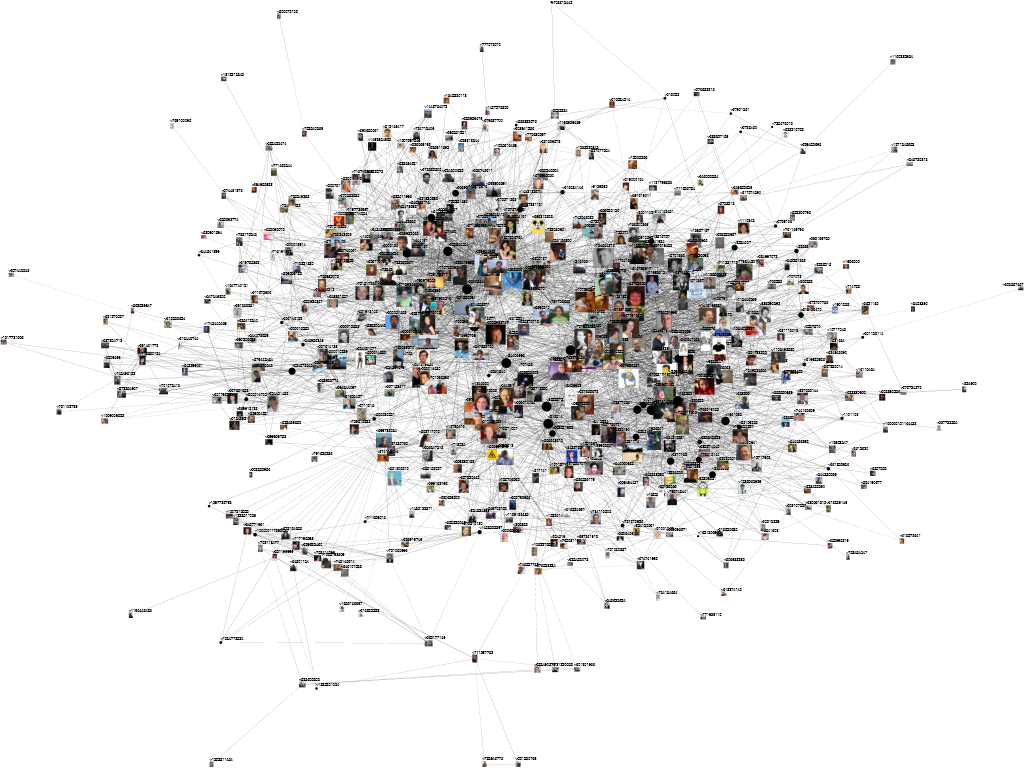
A map of the relationships among the population of people who all tweet a particular keyword can lead to the discovery of the key hubs and influential people in the network. A social network analysis of reply patterns in email collections displays clusters around projects and highlights key people and relationships. Visualizing the connections among your friends in Facebook can reveal the various life stages and communities in which you have participated. When you chart the links between videos and users in YouTube content with interesting network properties is exposed based on well connected content creators and influential commentators. A graph of the individual connections between flickr users illustrates the emergent formation of groups around social networks, locations, and topics.
These kinds of social media network data collection, scrubbing, analysis, and display tasks have historically required a remarkable collection of tools and skills. A great example of the variety of tools that can be used in concert to extract, analyze and display social media networks can be found on Drew Conway’s blog. This is a powerful set of tools for those who can master the demands of python and API interfaces. In contrast, the approach the NodeXL project has taken is to provide an end-user GUI application environment built within the framework of Excel 2007 for performing basic social media network analysis and visualization for non-programmers. The python path is certainly the high road for experts and those with demanding volumes or esoteric data requirements. But for the non-coding user, NodeXL may be one of the easiest ways to both manipulate network graphs and get graphs from a variety of social media sources.
There are already some materials available to guide new users interested in learning about NodeXL, social networks, and social media. A video tutorial for NodeXL demonstrates the extraction of the network of people in twitter who mentioned the term “digg”. A tutorial guide to NodeXL offers a step by step guide to features in the NodeXL toolkit (with supporting data sets). But the book will capture the theory, history, domain and process of social media network analysis in a single volume.
The volume contains a broad introduction to social media, social networks and the operation of the NodeXL application and then features a series of chapters from leading researchers that focus on a particular social media system (email, Facebook, Twitter, YouTube, flickr, Wikis, the WWW hyperlink network) and the networks each contains (replies, friends, follows, subscribes, comments, favorites, edits, links, etc). A final chapter outlines a programmer’s view of the NodeXL code, in contrast to the code-free approach of the remainder of the book.
Our intended audience is the mostly non-programming population that is interested in social media and the techniques of social network analysis. The volume is largely in the form of a how-to guide that readers can follow and replicate all examples. Using your own free and open copy of NodeXL, you will be able to use sample data sets or create similar live queries that map relationships in social media systems.
We have an ambitious production schedule so the book may be on a book store shelf or online retailer search result in summer 2010.
NodeXL has updated again (v.1.0.1.109) with new network metrics. The application now calculates path length data for your network, reporting the Maximum Geodesic Distance and the Average Geodesic Distance. The list of overall metrics NodeXL creates includes: Vertices (the number of…
NodeXL updated starting with version 1.05 with features that make it fairly easy to create basic "Venn Diagrams". A Venn diagram is a familiar way to illustrate the overlap (or lack thereof) of two or more "sets" of things. There…
Facebook recently announced its fellowship program for graduate students pursuing a PhD. Winners will receive tuition, fees, and a stipend for the 2010-2011 academic year. Anyone interested in applying should move quickly, as the deadlines are quite tight in order…