Facebook recently announced its fellowship program for graduate students pursuing a PhD. Winners will receive tuition, fees, and a stipend for the 2010-2011 academic year. Anyone interested in applying should move quickly, as the deadlines are quite tight in order…
Network visualizations can be very compelling but they are often a smear of unintelligible nodes and edges without refinement and filtering. Creating an automated layout for a complex graph is a challenging area of mathematics and computer science. Several layouts…
There are hundreds of conferences sponsored by the ACM on almost every topic related to computing. In some cases the same person will publish a paper in more than one conference, creating a tie between them. Below is a network…
Here is a recent slidedeck that provides an overview of NodeXL and social media network analysis. 2009 December NodeXL Overview View more presentations from Marc Smith. The deck illustrates the use of NodeXL to extract several social media networks from…
My colleagues on the Facebook Data Team recently posted the results of a study about the diversity of the Facebook user base. Using surnames from users in the United States and comparing the rates at which those surnames occur in…
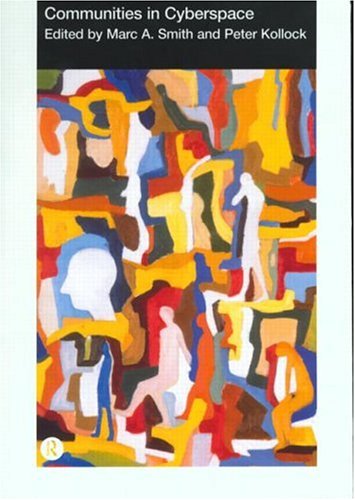
When the late Peter Kollock and I published Communities in Cyberspace with Routledge in 1999 there were few broadband connections, no iPhones, and little WiFi. Today, there is an ebook version of the book and Amazon sells a version for the Kindle, a device it was hard to even imagine when the book was written. Google lets you browse most of it and search all of it. But the key ideas of the volume: identity, interaction, collective action and emergent order remain relevant in a wireless broadband netbook mobile social network real-time web world. The book is now ten years old.
“Since 1993, computer networks have grabbed enormous public attention. The major news and entertainment media have been filled with stories about the “information superhighway” and of the financial and political fortunes to be made on it. Computer sales continue to rise and more and more people are getting connected to “the Net”. Computer networks, once an obscure and arcane set of technologies used by a small elite, are now widely used and the subject of political debate, public interest, and popular culture. The “information superhighway” competes with a collection of metaphors that attempt to label and define these technologies. Others, like “cyberspace,” “the Net,” “online,” and “the web,” highlight different aspects of network technology and its meaning, role and impact. Whichever term is used, it is clear that computer networks allow people to create a range of new social spaces in which to meet and interact with one another.”