The June 9 issue of New Scientist contains an article featuring a map of scientific citation that was generated by NodeXL. The article about the patterns of citation and the time to publication for US and non-US based scientists contains a map of which papers and authors cite which other papers and authors. From New [...]
by Dru! Can useful observations be made by studying the social media sea one bucket at a time? NodeXL has data import “spigots” for pulling social networks out of several social media systems including Twitter, YouTube, flickr, and email. Twitter networks of follows and followers, reply and mentions can be extracted based on either a [...]
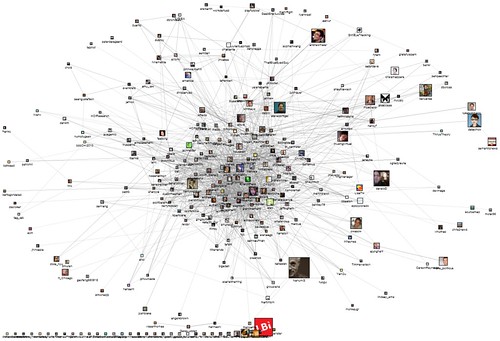
The oil spill disaster in the Gulf of Mexico is a topic of great concern to many people in twitter. This is the map of connections among people who tweeted the term "oil spill". There are lots of isolated authors,…
My colleague at the Oxford Internet Institute, Bernie Hogan, is working on tools that collect personal Facebook network data and visualize the connections among your friends. These tools now interoperate with NodeXL through the GraphML XML file format. Here is the…
From this:to this: in just a few clicks. Many network graphs contain disconnected smaller graphs, called "components", within them. Most layout algorithms do a poor job of managing to group each component in a separate space. Instead, often, components are…
Benefits This course provides an overview of Social Network Analysis (SNA) and demonstrates through theory and practical case studies how it can be used in HCI (especially computer-mediated communication and CSCW) research and practise. This topic is of particular importance due to the popularity of social networking websites (e.g. YouTube, Facebook, MySpace etc.) and social computing. As people increasingly use online communities for social interaction, new methods are needed to study these phenomena. SNA is a valuable contribution to HCI research as it gives an opportunity to rigorously study the complex patterns of online communication.
Social network theory views a network as a group of actors who are connected by a set of relationships. Actors are often people, but can also be nations, organizations, objects etc. Social Network Analysis (SNA) focuses on patterns of relations between these actors. It seeks to describe networks of relations as fully as possible. This includes teasing out the prominent patterns in such networks, tracing the flow of information through them, and discovering what effects these relations and networks have on people and organizations. It can therefore be used to study network patterns of organizations, ideas, and people that are connected via various means in an online environment.