The Twitter Chirp conference attracted tweets from many technology leaders and bloggers. Here is a ranked list of the top most “between” people who tweeted the term “chirp” in the last day. A complete social network map, with edge thickness proportional to the number of network connections (follows, replies, mentions) that link the two participants [...]
The CHI 2010 conference is well underway in Atlanta this week and lots of people are tweeting the #CHI2010 hash tag. An updated NodeXL map of the connections among people who use the #CHI2010 tag is below: This is the network map of follows, replies, and mentions relationships among Twitter users who mentioned “CHI2010″ as [...]
From this:to this: in just a few clicks. Many network graphs contain disconnected smaller graphs, called "components", within them. Most layout algorithms do a poor job of managing to group each component in a separate space. Instead, often, components are…
Last week I made a video with Norm Rose from Travel Tech Consulting about the ways different airlines get talked about in twitter. Norm explores new technologies that impact the travel business and he asked me to create two maps:…
Not all ties are the same. Many networks are collections of multiplex relationships: multiple types of ties link the entities in the graph. NodeXL now (v.1.0.1.120) supports edge styles so that links can have color, width, and style to distinguish…
Title: Visualizing collections of social media connections: using social network analysis to assess, evaluate and measure social media engagement
Abstract: Social networks are created whenever people interact. These networks become more visible when interactions take place through social media. Social networks form when people link, reply, comment, edit, tag, and friend one another. Sub-populations are formed whenever people mention the same company, products, event, topic, or personality. Using social network analysis on collections of social media connections reveals important patterns: how are people clustered and grouped, where are the gaps, who plays the roles of bridge, hub, and isolate? In this talk I will display maps of twitter, you tube, flickr, and enterprise email systems and demonstrate several tools that can be used to collect, analyze, map and monitor social media, including the free and open NodeXL (network overview, discovery and exploration) add-in Excel 2007.
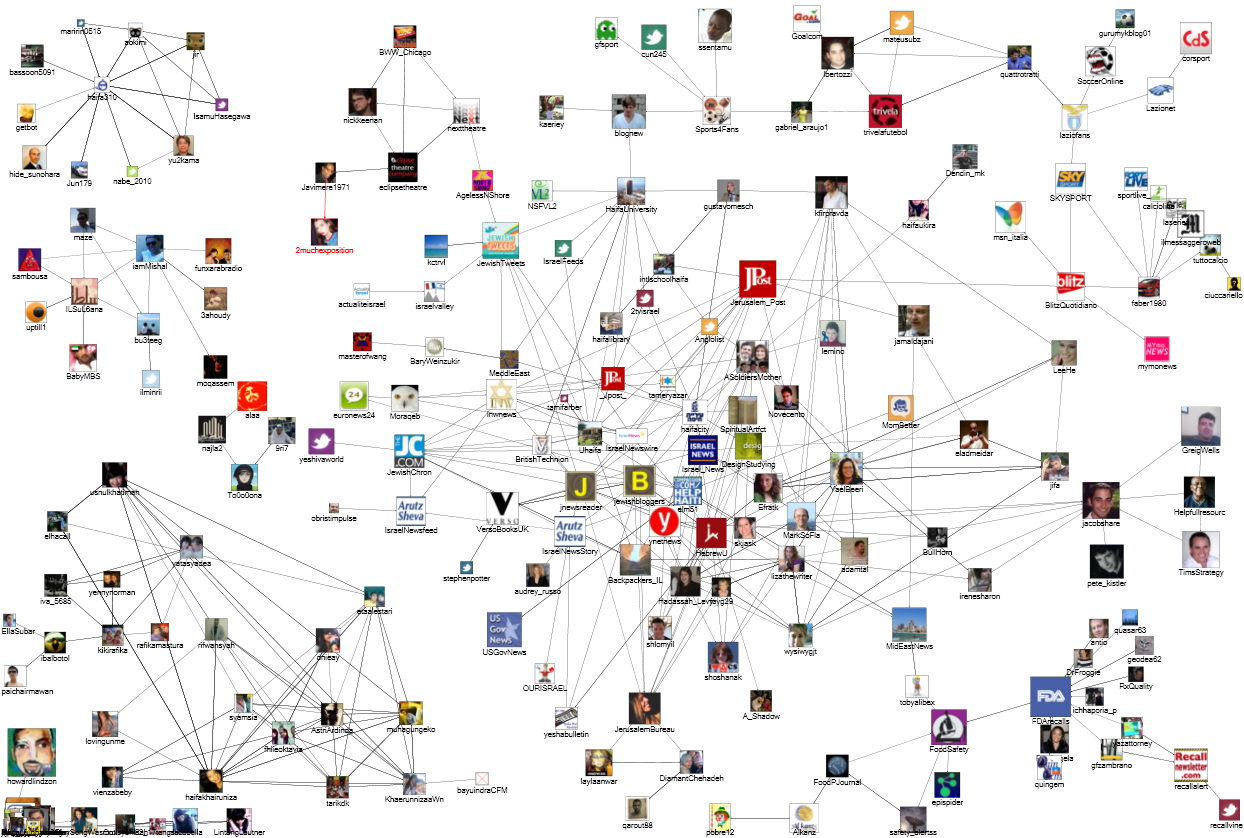
Here, for example, is a map of the connections among people who recently mentioned “haifa” in twitter sized by number of followers:
Some photos taken during the trip are available after the jump: