On December 15th in Mountain View, California join me for lunch and a workshop on creating social media network diagrams! We will provide a hands-on guide to creating maps of the collections of connections among people who tweet about various brands,…
This is a brief demo video about NodeXL analyzing Twitter social network connections among a group of users who all mentioned the term "digg". 2009 - November - NodeXL - Demo - Mapping Twitter Social Networks "Digg" from Marc Smith…
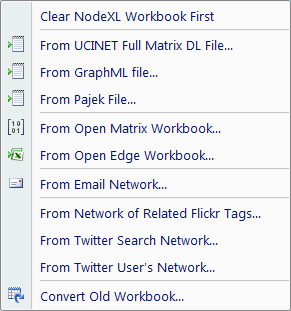
Version 95 of NodeXL is hot off the compiler and we are pleased to announce several major features that create a social media network analysis dashboard. From the NodeXL interface it is now possible to import networks from twitter, flickr, email, and a range of social network file formats. Coming soon: support for more spigots – the connectors that pull data from leading social media sources.
What social media data most interest you? We are considering integration with web and wiki crawlers, and support for YouTube, delicious, and enterprise data sources like Active Directory (LDAP), SharePoint, and Exchange.
This release also improves support for images, particularly those pulled from URLS, like twitter or facebook profile photos!
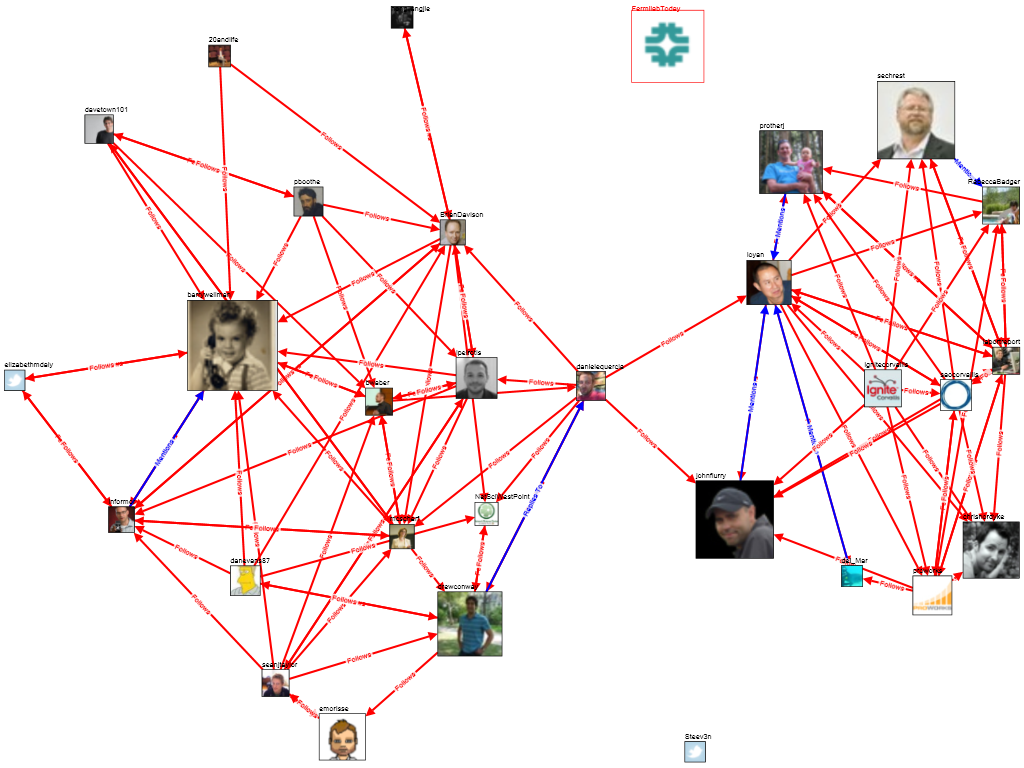
Here, for example, is a map of the connections among twitter accounts that tweeted the “WIN09” tag that was used in the recent Social Networks Summit at NYU (http://winworkshop.net/) The map illustrates the way the summit brought together previously separate clusters of people from the various disciplines that have been attracted to the study of networks in general and social networks in particular. Size of the image equals the number of tweets that person created.
A refined version adds Edge Labels and color to highlight the different tie types in the graph: “follows” relationships and “replies to” and “mentions” and now scaled by “Followers”.
In both views, the high betweenness role of one twitter account is clear.
A recent paper makes use of NodeXL to create illustrations of data from connections among twitter users drawn from the United States presidential debates in October 2008. One illustration highlights the major clusters in the network. Tweet the Debates: Understanding…
My colleagues Derek Hansen and Ben Shneiderman (University of Maryland) and I have just finished the second version of our tutorial/manual for the NodeXL social network analysis toolkit for Excel.
The latest version of the tutorial Analyzing Social Media Networks: Learning by Doing with NodeXL is now available from the University of Maryland Center for the Advanced Study of Communities and Information (CASCI) web site. We will use this version of the document in our upcoming tutorial at the Communities and Technologies conference at Penn State University on June 24th.
We plan to continue to expand the tutorial to include a step-by-step guide to the analysis of several major social media sites like Twitter, Facebook, Wikipedia, YouTube, delicious, and flickr as well as personal stores of social media like your own email (if it is stored in a Windows Search Index found on most Windows desktops). Our goal is to create an easy-to-follow guide to network theory for people who new to the field or who do not want to develop programming skills to perform network analysis. We are focused on social media as a data source for social media although other examples are included, like the United States Senate voting network that reveals interesting patterns in the connections created when votes are cast. Using 2007 data it reveals which Senators are most likely to change party affiliation.
Your comments, corrections, and suggestions for improving the document are welcome.
Instructors interested in teaching classes about social networks are welcome to make use of both the NodeXL toolkit and the document to guide students through the core concepts of social network theory.
The Communities and Technologies conference is holding its 4th meeting in Penn State June 24-27. This conference gathers a range of scholars interested in online community, social media, social networks, and mobile social software. A paper "Analyzing (Social Media) Networks…